The State of Martech 2026 Report: Fewer Apps, More Consolidation

The stats are very different this year
Welcome to the season where marketing and technology tools unite, helping teams gain realistic insights on how other companies are organizing and activating their tech stacks in efforts to work smarter, not harder. On May 5, Scott Brinker of Chiefmartec officially released his annual Marketing Technology Landscape supergraphic and 125-page report — and there are some surprising factoids to unpack.
Before we get started, we’d be amiss if we didn’t mention the previous decade of statistics have centered on industry growth: more apps and tools, more categories, and more complexity. In an interesting twist, 2026 has stacked up to be quite different, so let’s dive in.
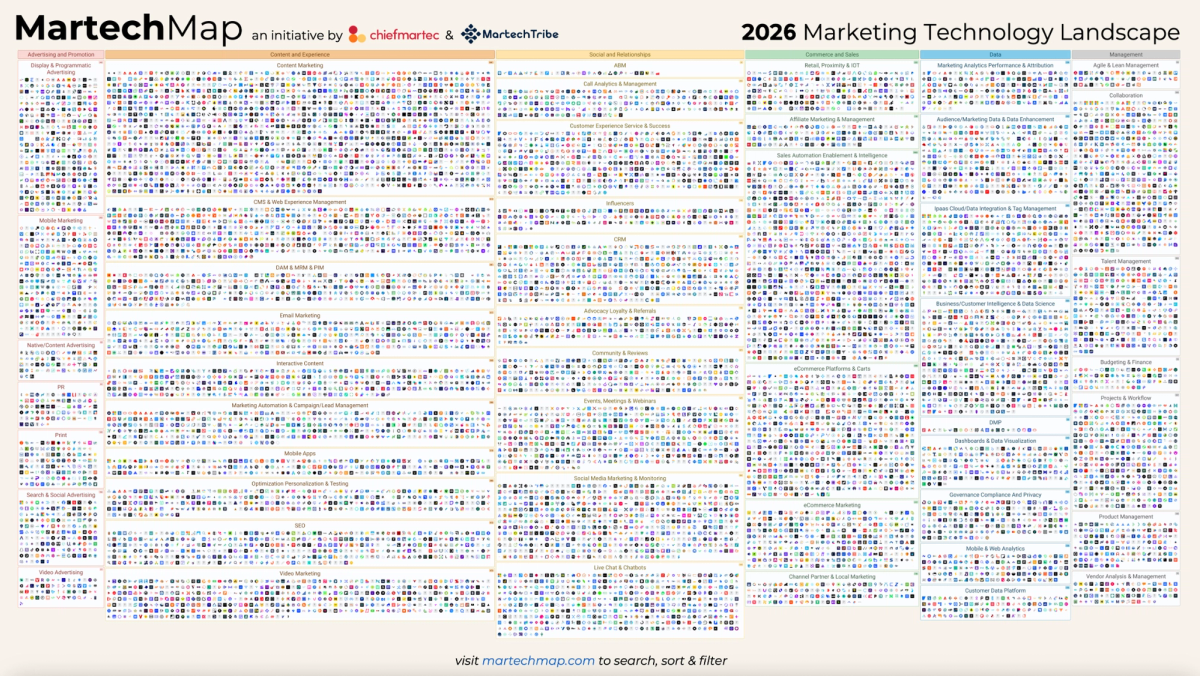
Check out the 2026 Marketing Technology Landscape
Graphic courtesy of Scott Brinker and Chiefmartec.com
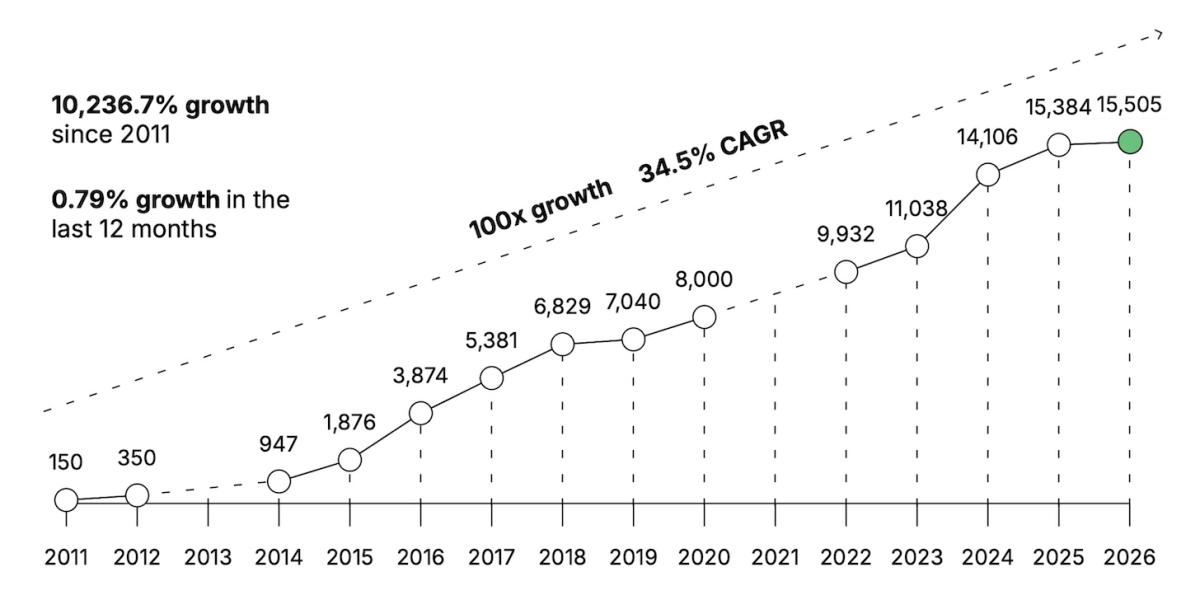
According to the State of Martech 2026 report, the marketing technology landscape slightly grew from 15,384 solutions in 2025 to 15,505 in 2026. That’s a shockingly modest increase of just 0.79%, after seeing last year's solid growth of 9%. So, what in the martech is going on?! After 15 years of explosive expansion, the industry may have finally reached what Brinker calls “peak martech.” However, the real story this season isn't about stagnation, it’s about transformation.
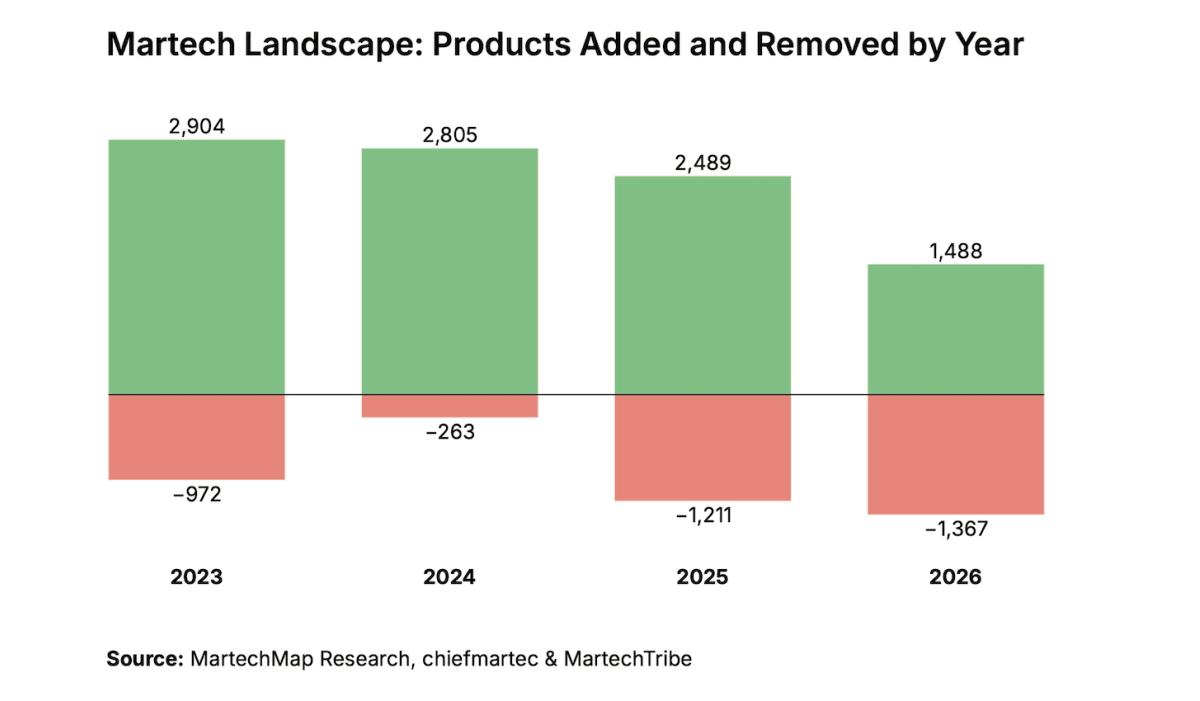
Beneath the surface, the market experienced significant churn. Nearly 1,500 products were added while more than 1,300 disappeared, signaling a major shift in how organizations evaluate, consolidate, and deploy technology.
Graphic courtesy of Scott Brinker and Chiefmartec.com
“The largest cohort of the departed came from the 2010-2019 SaaS wave, accounting for 51.7% of this year’s exits. In other words, this isn’t just a bonfire of tiny AI wrappers launched during the first ChatGPT gold rush. A meaningful portion of the first great SaaS martech generation is now being cycled out.” — Scott Brinker, Chiefmartec
For teams already feeling overwhelmed by app overload, browser tab fatigue, and fragmented workflows, this year’s findings may sound familiar. Below is a breakdown of the latest stats:
- 15,505 martech solutions in 2026 (vs. 15,384 in 2025, 14,106 in 2024, 11,038 in 2023)
- Just 0.79% growth year-over-year
- 1,488 new products added
- 1,367 products removed
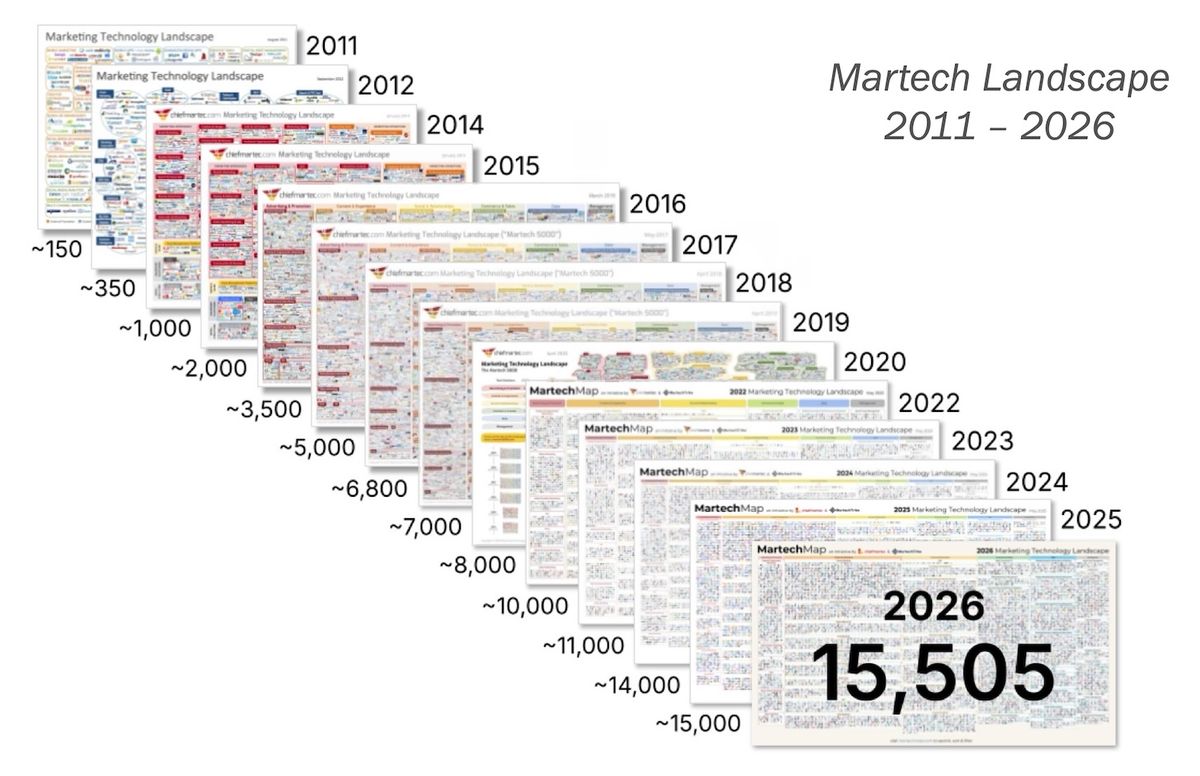
- Landscape grown from 150 solutions in 2011 to more than 15,500 today
- AI is increasingly shifting value away from standalone apps and toward orchestration, integration, governance, and infrastructure layers
Graphic courtesy of Scott Brinker and Chiefmartec.com
Are martech products vetted for the map?
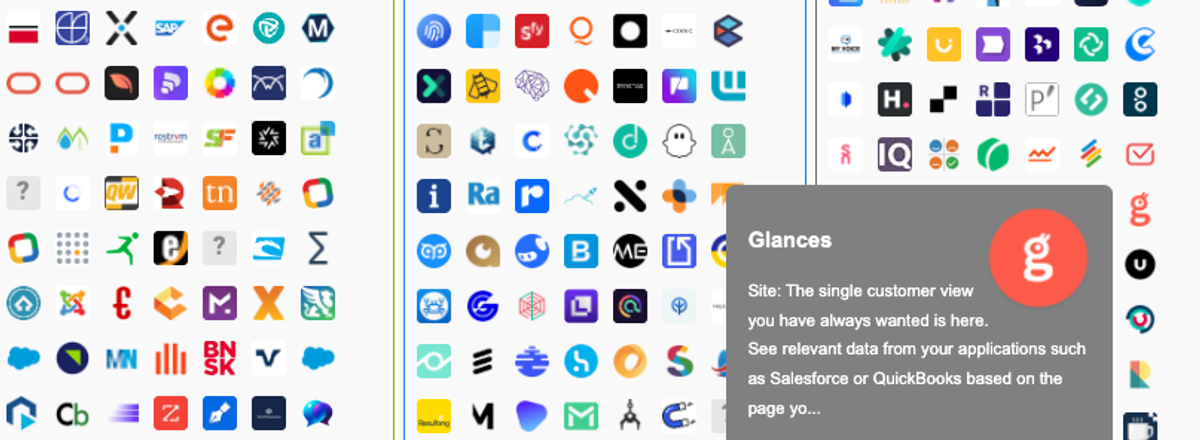
The quick answer is yes, which our team was happy to learn. While the Marketing Technology Landscape supergraphic is massive, not just any product entry gets listed. Brinker and team review new candidates and ensure the map is up to date, removing apps that are out of business or may have been acquired. For example, 11,133 new candidates were reviewed in 2025 and only 2,489 had the right qualifications. With that said, this seems like the proper time to mention that Glances made the cut (again) and remains listed on the supergraphic!
You can view and download the slide graphic here or go to the interactive website at at martechmap.com. Hint: search and find Glances listed on the massive map under the Projects & Workflow category!
Martech isn't growing, it's reorganizing
For years, the default response to new business challenges was adding shiny-new SaaS tools, often ones that overpromised and underdelivered. Need collaboration, want better analytics, or embracing more AI? There’s not just an app for that, there’s dozens to hundreds per category in the space. The result has been increasingly complex tech stacks that require employees to constantly switch contexts, toggle between tabs, and hunt for information across disconnected systems. The 2026 report shows that era may be fading.
Instead of accumulating more software, organizations are becoming more selective. Vendors are disappearing, categories are consolidating, and companies are looking for ways to simplify how work gets done rather than simply expanding their stack. That's an important distinction to recognize, because the challenge facing modern teams isn’t the lack of tech or options — it’s managing too much of it.
For our own team, our decades of experience in software integrations empowered us to see this trend coming. It’s one of the main reasons we created Glances as our patented no-code integration platform for teams everywhere to easily view data and perform actions across multiple business apps.
AI is accelerating consolidation
One of the report’s biggest themes is the emergence of AI as the new value layer in martech. Historically, individual SaaS apps created value by owning specific workflows. Today, AI is beginning to sit across workflows, helping users generate content, analyze data, automate decisions, and orchestrate actions between systems. This shift is changing how organizations think about software investments. When AI can connect information across multiple systems, teams naturally begin asking:
- Do we need another standalone app?
- How many tools perform overlapping functions?
- Could we reduce complexity without sacrificing capability?
These questions are driving the consolidation trends highlighted throughout the report. For marketers and operations leaders, fewer tools often translates to less context switching, faster decision-making, and improved productivity.
The hidden cost of tool overload
While the State of Martech report focuses on the technology landscape, its findings point to a broader workplace reality. Most knowledge workers don't struggle because they lack information; they struggle because information is scattered.
Every notification, browser tab, application, dashboard, and login creates friction. Employees spend significant portions of their day moving between systems to gather context before they can actually complete meaningful work. As martech stacks expanded over the past decade, the number of digital destinations employees must navigate expanded alongside them. The result? More interruptions, more app switching, and more fragmented attention.
The flattening of the martech landscape may indicate that organizations are finally recognizing the productivity costs associated with software sprawl.
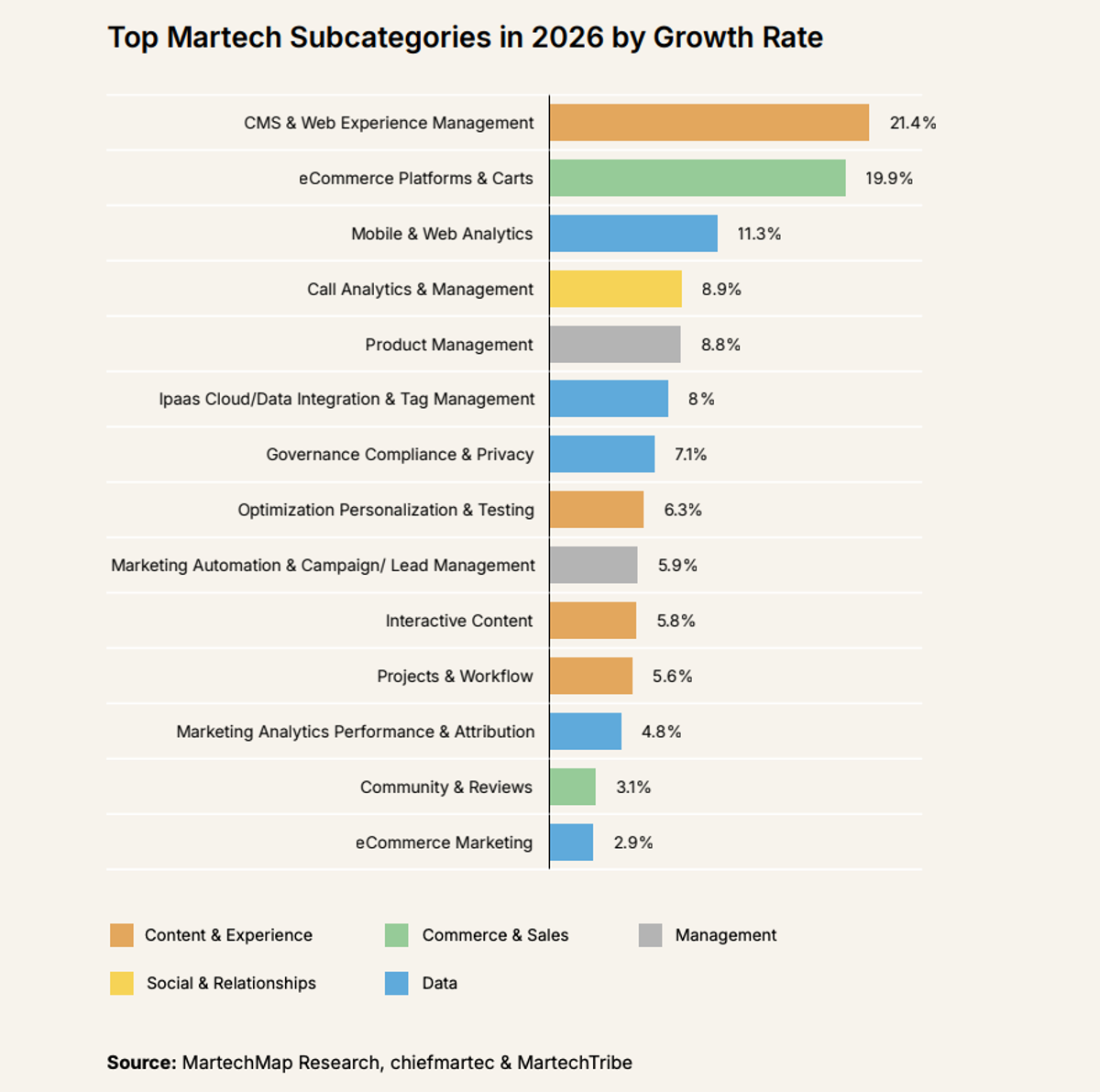
Graphic courtesy of Scott Brinker and Chiefmartec.com
From more apps to better experiences
Perhaps the most interesting takeaway from the 2026 report is that the industry conversation is shifting away from software quantity and toward user experience.
For years, success was measured by how many tools a company had adopted. Today, leaders are increasingly asking a different question: how easily can employees access the information they need to do their jobs? That shift aligns with a growing focus on digital employee experience, workflow efficiency, and reducing unnecessary friction throughout the workday. Technology should help teams stay focused — not force them to become expert navigators of an ever-growing stack of apps.
What this means for the future of work
If peak martech has truly arrived, the next phase won't be defined by adding more tools. It will be defined by connecting the ones we already have.
Organizations are looking for ways to reduce friction, surface relevant information faster, and create more streamlined experiences across the applications employees use every day. The “winners” won't necessarily operate with the largest tech stacks. Instead, the future of martech lies within those that can make tech feel simpler and provide a more thoughtful approach to how people actually work.
We hoped you enjoyed our team’s annual recap of The State of Martech report. We truly appreciate all the hard work Scott Brinker of chiefmartec.com, Frans Riemersma, and MarTech.org do to bring this set of industry stats to light. Download the full (and free!) 2026 report here.
Simplifying app integration is one glance away
Tech stacks will always evolve, but one thing remains constant: you need to be able to access your data in the precise moment you need it. Whether your stack is a humble 3 apps or dozens of different platforms, Glances acts as your seamless source of truth for not only viewing data, but completing multi-tasking Actions across your favorite business apps. Built with patented, no-code technology and backed by 5-star support, Glances helps you avoid the unnecessary data-syncing, downtime, and maintenance costs of traditional integrations.
More helpful steps
Schedule a demo to see the time-saving benefits of Glances in action or ask our team questions.
If you need to connect a specific app or platform with Glances that is not currently available on glances.com, please send your requests to hello@glances.com.
Find more step-by-step articles with the latest information on our support site.