AI Series Part II: 4 Ways to Leverage AI Effectively for Your Business

Now that we’re familiar with some trends for AI, the next step is to learn how to capitalize on those trends to gain a competitive edge. Let’s look at four ways to leverage Artificial Intelligence and Machine Learning (AI/ML) effectively, particularly within the Software as a Service (SaaS) space.
1. Product development
According to Maria Vasserman of Canny, using AI/ML to streamline product development processes is a great way to stay ahead of your competition. Think of those mundane, time-consuming tasks that no one wants to do: analyzing user data, testing features, fixing coding errors, and the like. With minimal human involvement and effort, AI/ML can take over this kind of work for you.
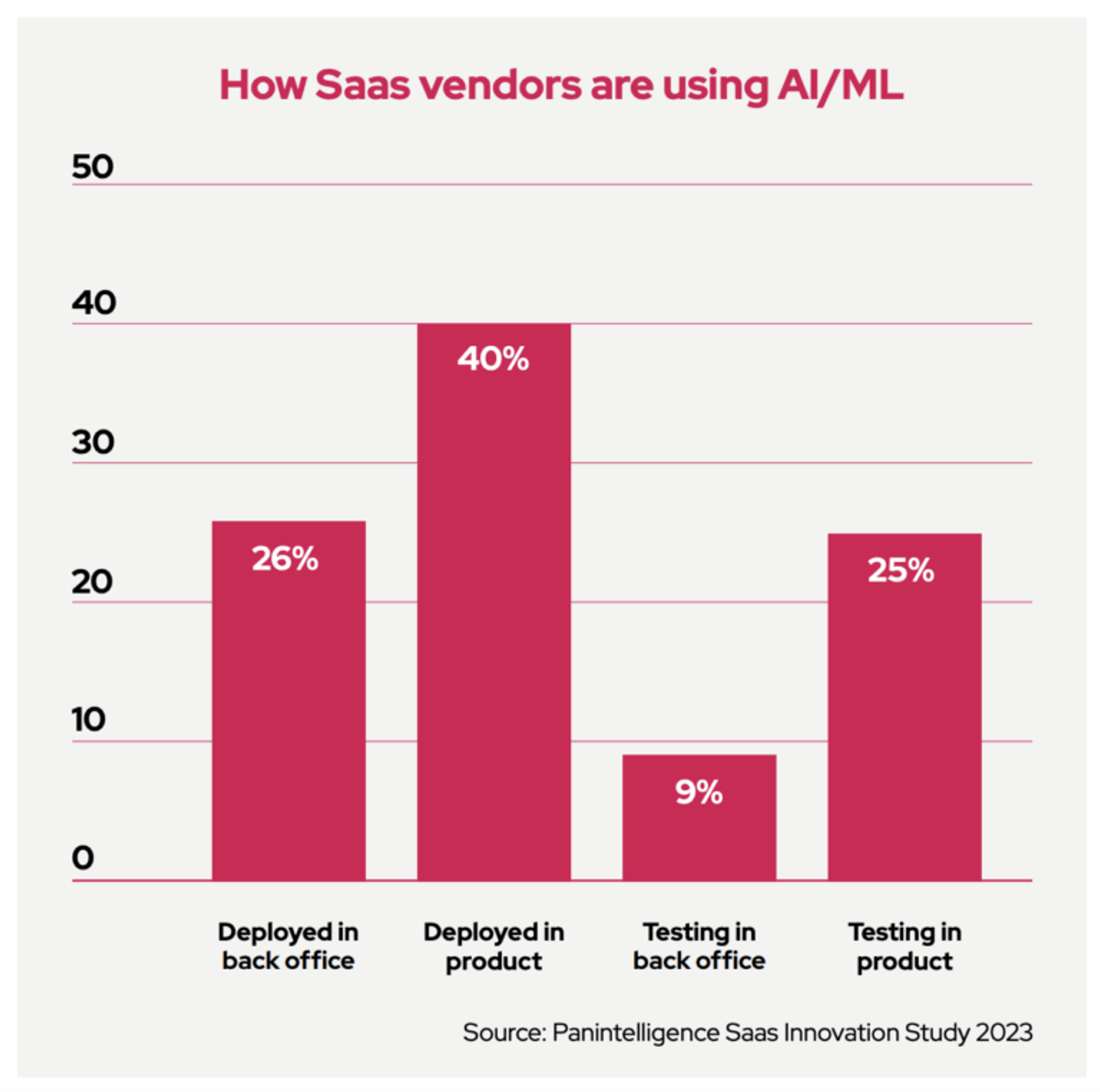
Graph courtesy of Squash Labs Inc.
For example, generative AI tools (e.g., ChatGPT) can produce a list of the most-requested features from user reviews or make recommendations for optimizing current code. AI/ML can also create product/feature prototypes based on analytics of current user behavior and scan system logs for any security threats.
2. Cost reduction
Like most other technological advancements, AI/ML is increasing efficiency and productivity, thereby reducing costs for businesses of all kinds. John Crabill of eLearning Industry explains that savings usually come in the form of lower labor costs, better resource allocation, faster content generation, decreased maintenance costs, and reduced recruiting and onboarding costs.
Businesses—especially those with extensive computing resources—can leverage AI/ML to “analyze historical usage patterns and predict future demand, allowing SaaS platforms to scale resources up or down in real-time,” writes Shanjidah Jafar of Squash. In addition, because of sophisticated algorithms that ensure efficient operation and predictive analytics that anticipate performance issues, AI/ML can enhance product/service reliability, which improves user trust and satisfaction.
It’s important to note that adopting AI/ML tools comes with its own costs: purchasing the software, learning how to use it, and fixing it when it’s not working properly, for instance. Any business considering implementing AI/ML strategies should take these costs into account.
3. Customer support
Veza Digital explains that even a simple AI-powered chatbot can improve the efficiency and effectiveness of customer service. These chatbots can manage the most common customer questions and concerns by using historical data. In fact, according to Beata Stefanowicz of Tidio, “over 87% of customers report that chatbots are effective in resolving their issues.” This reduces response times and allows human customer support representatives to focus on more complex issues.
In addition, AI/ML can employ natural language processing (NLP) to train itself to provide more accurate answers and better imitate human conversations. In this way, AI/ML is not just helping to resolve customer service tickets; it’s helping businesses build relationships with users, cultivating brand loyalty over time much in the same way that human employees can. This positions AI/ML as an intuitive and responsive partner in enhancing the user’s experience.
4. Growth and scalability
Perhaps one of the most valuable ways businesses can leverage AI/ML is for growth and scalability. To outperform the competition, businesses need speed and agility—two things which AI/ML happens to be really good at.
For instance, Vasserman explains that tools like Looker and Tableau can locate usage gaps in your product/service while Salesforce, HubSpot, and Gainsight can connect those gaps to churn. From there, AI/ML-driven tools like Marketo and Dynamic Yield can help fill those gaps and improve user retention.
AI/ML systems can also grow along with your business. Technology Rivers explains that “scalable AI solutions can adapt to increasing data volumes and evolving business requirements.” Unlike more static technologies that require major upgrades, AI’s ability to learn over time means it “can handle increased loads and more complex tasks without significant overhauls.”
How Team Glances uses AI/ML
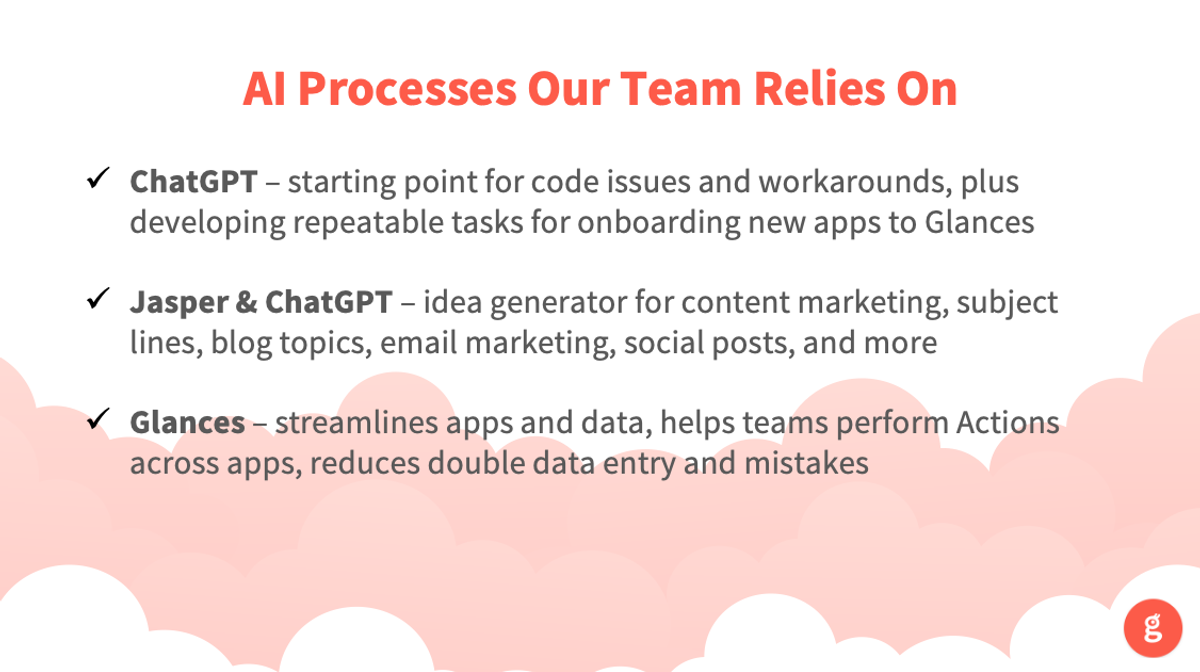
Our own team regularly uses AI/ML for many of the reasons explained above. These tools become powerful sidekicks for our human employees, freeing them up to engage with the meaningful and creative work they’re so good at.
In fact, back in February, our CEO, Jason Eggers, joined Software Oasis host Michael Bernzweig and a full panel of industry experts to discuss AI-powered process optimization for small-to-mid-sized businesses. You can check out that conversation along with a variety of other webinars here.
Get started with AI/ML by using Glances
If you’re ready to start incorporating AI/ML techniques into your business, Glances is a great place to start! Our no-code platform allows you to automate tasks and improve workflows, thereby reducing mistakes and improving efficiency. Use Glances to connect your most-used business apps all in one place, allowing you to work within whichever app or website you wish.
And with Glances Actions, you can create streamlined workflows that can save you up to 20 minutes per task.
See how it all works with a free trial of Glances today!
More helpful steps
Schedule a demo to see the time-saving benefits of Glances in action or ask our team questions.
If you need to connect a specific app or platform with Glances that is not currently available on glances.com, please send your requests to hello@glances.com.
Find more step-by-step articles with the latest information on our support site.